
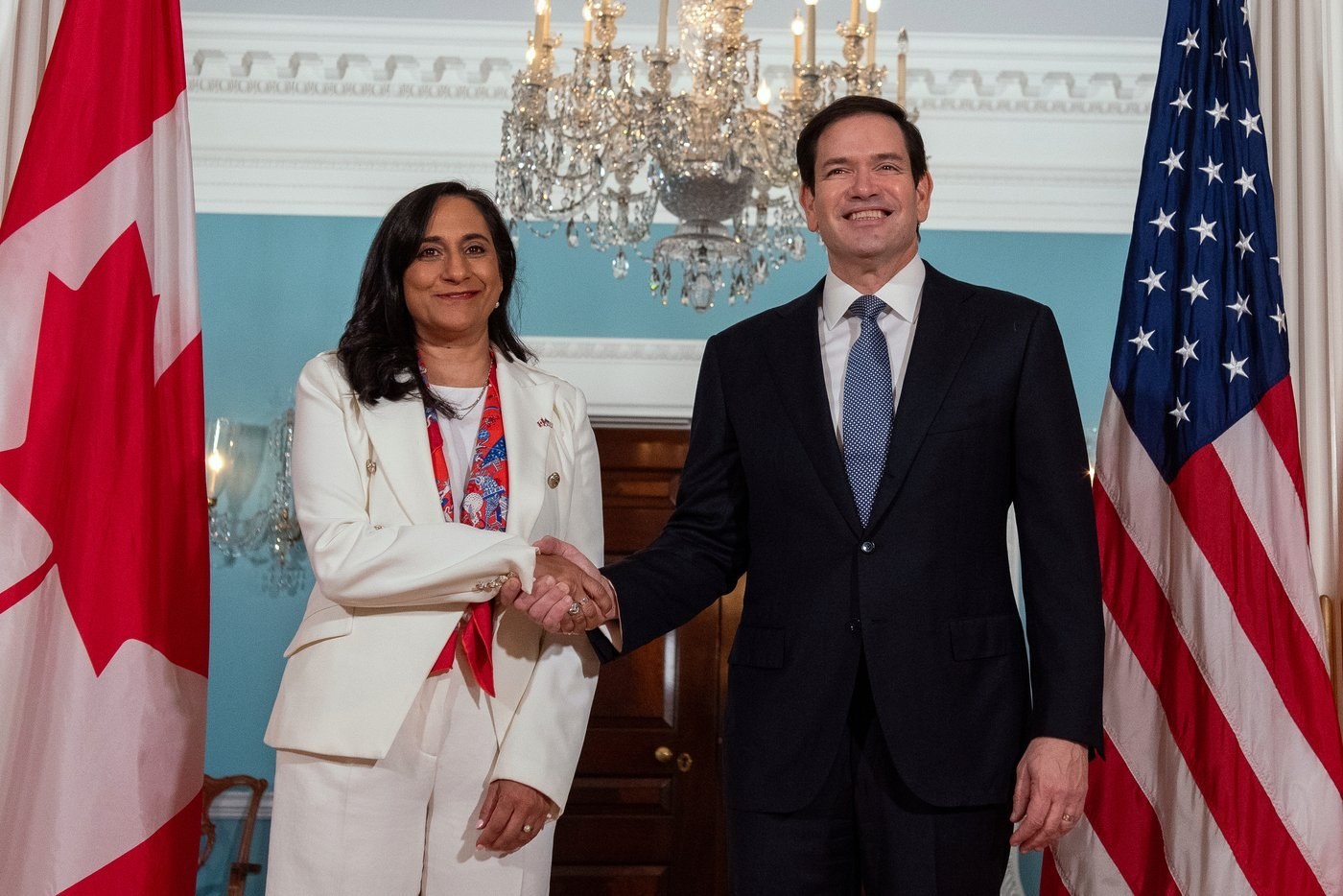
Let’s be clear: Canada is utterly complicit with US imperialist aggression against the peoples of Latin America and the Caribbean.
Ottawa was complicit with the extra judicial killings in the form of missile strikes on marine vessels in the Caribbean. It was complicit with the US military strikes against Venezuela and the kidnapping of President Nicolás Maduro and his wife Cilia Flores. It was and remains complicit with the seizure of Venezuelan oil tankers. Through its silence and inaction, it is complicit with Trump’s recent escalation of the US blockade against Cuba.
And Ottawa is complicit with the broader implications that these crimes engender: the flagrant breach of international law and an erasure of nations’ just claims for self-determination. But complicity, in this instance and as it pertains to the Canadian state, is not a matter of simply standing idly by a crime unfolds but rather the direct participation in that very crime!
To understand how Canada is an active participant in US imperialism, we have to understand that Canadian foreign policy follows economics. Through the deep and comprehensive integration of the Canadian economy with the US economy, and with the US economy being roughly fourteen times larger than the Canadian economy, US interests quickly become Canadian interests. To put it more precisely, US interests quickly become Canadian business interests. Needless to say, these are not the interests of working people in Canada.
So, US foreign policy becomes Canadian foreign policy. When asked recently how the Carney government’s policy towards the Global South differs from that of past prime ministers, Canadian Network on Cuba cochair Julio Fonseca said simply, “they are all the same, copied and pasted from Wastington.”
What’s good for US business is good for Canadian business, and working people, students, disabled and retired folks can be damned. Moreover, these shared economic interests need to be backed up, and backed up by force in the event there be any threat to this US global hegemony.
This is why Canada has agreed to hit NATO’s military spending target of 5 percent of GDP by 2035, estimated at $150 billion annually.
This is why Canada is so hell bent on purchasing 88 F-35 fighter jets, to contribute its fair share to the binational military alliance known as NORAD.
This is why Canada invests an undisclosed amount into the Five Eyes intelligence-sharing alliance between the US, Britain, Australia and New Zealand.
This is why Canada participates in the US-led Operation MARTILLO to suppress “drug trafficking” in international waters in Latin America and the Caribbean.
Each and everyone of these initiatives is designed to enforce a geopolitical order that suits the US economy. This remains true even while the geopolitical tectonic plates begin to shift, as Western capital increasingly recognizes the volatility of US hegemony and seeks stabler markets elsewhere. To translate Mark Carney’s Davos speech, the breaking of international law – or at least the way it is being broken by Donald Trump – does not benefit Canadian business in the ways it once did.
But are we to believe that Carney’s overtures to Europe and for greater integration with its markets will somehow manufacture a more benevolent global economic order? Lets not for a second confuse capital’s drive for stable markets as the ushering in of an era of peace. On the contrary, as the temporary peace between Western powers wanes, new inter-imperialist rivalries will emerge.
There is no denying that within this there may emerge new possibilities for the countries of the Global South to maneuver and for progressive and anti-imperialist movements to take root. But there are also great dangers and new risks of war, and Trump’s January 3 aggression against Venezuela puts that into sharp focus. US hegemony is waning but it is not gone, and as it wanes it will become increasingly unpredictable and unstable.
In this context, solidarity with the peoples of Latin America and the Caribbean – Cuba and Venezuela in the first instance, but also Colombia, Nicaragua, Brazil and elsewhere – is one of the most important fronts in the global struggle for peace. We must do what we can to encourage our friends, family, co-workers, unions and elected officials to appreciate that fact.
We need to build a mass movement to demand a new, independent foreign policy based on peace, disarmament and solidarity, and which includes unilateral withdrawal from military alliances like NATO and NORAD. We need to press for a multilateral and mutually beneficial trade policy, instead of corporate trade deals like USMCA.
We need to act now, to demand an end to Canadian complicity with US aggression against the peoples of Latin America and the Caribbean.
– Toronto Association for Peace and Solidarity